Anyone whose balance at ALTA is above €50,000. The amount is counted across all of a person’s accounts and deposits at the bank together, with interest up to the day bankruptcy is opened (Law on Deposit Insurance, art. 16 para. 1). A dinar deposit is counted in dinars, a foreign-currency deposit in euros. To check against the limit, dinars and other currencies are converted into euros at the National Bank’s middle rate on the day bankruptcy opens (art. 2 item 7 and art. 17 of the same law). If you hold both dinar and foreign-currency deposits, the insured amount is paid in dinars and euros in proportion to each currency’s share (art. 17 para. 2). Your claim is your total minus the insurance payout. AOD will calculate the exact figure.
Deposits of people and companies connected with the bank are not insured and do not count towards the €50,000. If a deposit secured a loan at ALTA, only the deposit minus the debt is insured (arts. 2 and 16 para. 2 of the same law). Large companies and state bodies have no insurance at all.
In writing, to the Commercial Court in Belgrade (Privredni sud u Beogradu): the bankruptcy court is the one where the debtor has its seat (Law on Bankruptcy, art. 111 para. 1 and art. 16). Court address: Masarikova 2, Belgrade. The court opened bankruptcy on 03.11.2026; the decision is posted on the court’s electronic notice board, and case progress by number is on the courts portal (how to search: home page). On 04.11.2026 AOD published a claim template; see below.
The deadline is running: the notice appeared in the Official Gazette on 6 Nov 2026
The court decision of 03.11.2026 is not the start of the count.
Day 0The notice is published in the Official Gazette (does not count)6 Nov 2026
Days 1–90Ordinary filing: up to day 90day 1 — 7 Nov 2026; day 90 (the last) — 4 Feb 2027
Days 91–120A fallback that requires paying for an additional court hearing, not the filing deadline. Without that advance the claim is rejected.from 5 Feb 2027 to 6 Mar 2027 Day 120 is 6 Mar 2027 (Saturday). If the court does not work that day, the period moves to the nearest working day (art. 103 para. 4 Civil Procedure Law) — 8 Mar 2027
After day 120The claim will not be accepted: it is dismissed as late.
How we count: the first day of the period is the day after publication. If the last day falls on a weekend or holiday, the period ends on the next working day; holidays are not accounted for above, so file earlier. The notice came out on 06.11.2026: that day does not count (art. 103 Civil Procedure Law), day 1 is 7 November.
90 days from the day the bankruptcy notice appeared in the Official Gazette (06.11.2026). Not from the licence revocation and not from 3 November. The court set this deadline in decision 10 St 275/2026 of 03.11.2026 (item IV), and AOD’s forms page says the same. The deadline runs from publication (art. 7): the notice appeared in No. 109 of 06.11.2026. File without waiting for the insurance payout. For comparison, at Univerzal the court gave 60 days.
The Official Gazette (Službeni glasnik) and the bankruptcy notice
Now. According to the courts portal, the court sent out the notice of the opening of bankruptcy on 03.11 (how to check the case). The notice was published in the Official Gazette No. 109 of 06.11.2026, section “Court notices”, item 172 (text of the notice; web archive copy; issue No. 109 of 06.11.2026). Claim for the amount above €50,000 — by 4 February 2027. Where this deadline comes from → Item IV verbatim: “Позивају се повериоци стечајног дужника да у року од 90 дана од дана објављивања огласа о покретању поступка стечаја над стечајним дужником у „Службеном гласнику РС”, пријаве Привредном суду у Београду своја обезбеђена и необезбеђена потраживања.”
Why it matters. The 90 days for a claim run from publication in the Official Gazette, not from the court decision (10 St 275/2026, item IV; Law on Bankruptcy of Banks, art. 7). If you are late, you can still file, but no later than 120 days after publication. To do so you must pay an advance for an extra court hearing. After that the court rejects the claim (Bankruptcy Law, art. 111 paras. 5 and 8).
How it went with Univerzal banka. The court opened bankruptcy on 03.02.2014, the notice appeared in Official Gazette no. 14 of 07.02.2014 and the filing deadline was 60 days (Gazette page, web archive). Three days after the court decision AOD published instructions on its website on how to file a claim (AOD instructions).
Where the notice itself is
What it is. “Službeni glasnik Republike Srbije” (Službeni glasnik RS) is Serbia’s official gazette. Its notices section (oglasni deo) carries notices from authorities, courts and companies (Službeni glasnik).
Where the notice of the opening of bankruptcy appears. The court must post it on its notice board and electronic notice board, print it in one high-circulation daily newspaper and publish it in the Official Gazette (Bankruptcy Law, art. 71 para. 3). For banks this law applies wherever the Law on Bankruptcy of Banks does not say otherwise (art. 22).
What it contains. Everything in the court decision (art. 71 para. 4): the court; the bank’s name, registration number and address; the administrator (for ALTA, AOD); the call to creditors to file claims and the deadline; the call to the bank’s debtors to pay; the date, time and place of the claim review hearing; the day the notice was posted on the court board (art. 70). For ALTA the decision gives no hearing date: it is held no later than 60 days after the six-month claim review period ends (court decision, items VI–VII).
Where to look.
The court board: free. Open the electronic notice board of the Commercial Court in Belgrade, section “Rešenje o pokretanju stečajnog postupka (otvaranju)”. The case row shows the number, dates, parties (“Lica”) and a “Preuzmite” (download) link.
The AOD website: free. Watch the news on aod.rs: AOD is the administrator in ALTA’s bankruptcy.
The Official Gazette: paid. The electronic edition is available only with a paid subscription (terms and prices). Without a subscription, use the court board and aod.rs.
The daily Danas. On 03.11.2026 the court sent the notice opening bankruptcy for publication in the daily Danas and in the Official Gazette (court press release, 06.11.2026).
How to see the original of issue No. 109. ALTA’s notice is in the Official Gazette of the Republic of Serbia (“Službeni glasnik RS”) No. 109 of 06.11.2026, section “Court notices”, item 172, page 64 of 80 in the PDF version of the issue. The text of the notice itself is free (link above). The full PDF of the issue on pravno-informacioni-sistem.rs opens only with a subscription. An electronic subscription to “Službeni glasnik RS” is sold on the publisher’s website: on 08.11.2026 it costs 16,643 RSD (discounted), and the current price is on the subscription page; with it the issue gets a PDF button on the portal. You can sign up from abroad too. The publisher sells the printed issue separately: 517 RSD in its online shop and in the publisher’s own shops (“maloprodajni objekti”); whether No. 109 is in stock, ask the publisher: [email protected], +381 11 30 60 580. The portal’s terms forbid publishing a copy of the issue or its pages on other sites without the Gazette’s written consent, so we give links only.
The payout up to €50,000 is separate: what to bring.
What Univerzal depositors were asked for in 2014 — not instructions for ALTA
An ID and a document proving the claim, with a copy (deposit or account agreement, passbook, account card, inheritance decision). For ALTA, AOD published its own list on 06.11.2026 (what to bring); the document is shown only in the original (AOD announcement, 2014).
Authorisation to collect the insured amount (ovlašćenje)
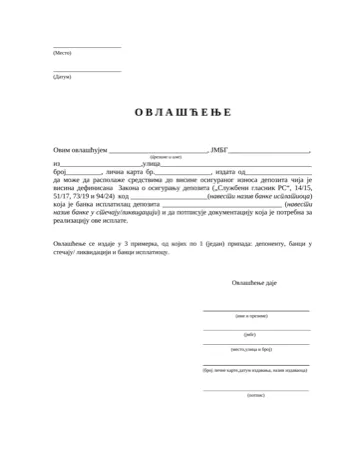
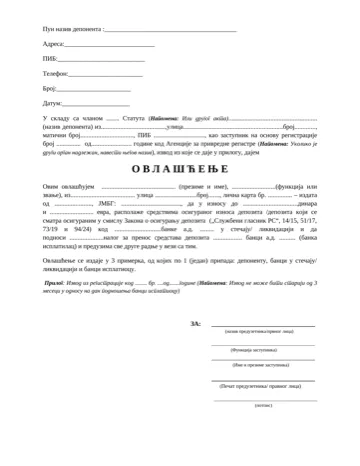
If you cannot come to a Banka Poštanska štedionica branch yourself, another person can collect the insured amount up to €50,000 under an authorisation. The authorisation forms (for an individual and for a company) are in the AOD forms block.
The authorised person can collect funds up to the insured amount and sign the documents needed for the payout. Both forms are made in three copies: for the depositor, the bank in bankruptcy and the paying bank. For a company or sole trader, if someone other than the registered representative comes, AOD requires an authorisation on company letterhead naming that person, signed by the representative and stamped, plus the OP form and the authorised person’s ID card (a passport as an exception) (AOD, questions and answers on ALTA).
Certification and documents from abroad. According to AOD’s answers for ALTA, the power of attorney is made at a notary (javni beležnik); if you are abroad, it is translated into Serbian and certified with an apostille (AOD, questions and answers on ALTA). On AOD’s forms page, the form for individuals says the power of attorney must be certified by a notary, dated no earlier than 30.10.2026 (the day the licence was revoked); powers of attorney issued before the revocation are not accepted at Poštanska (AOD forms). If you have no JMBG, see below, at the claim template.
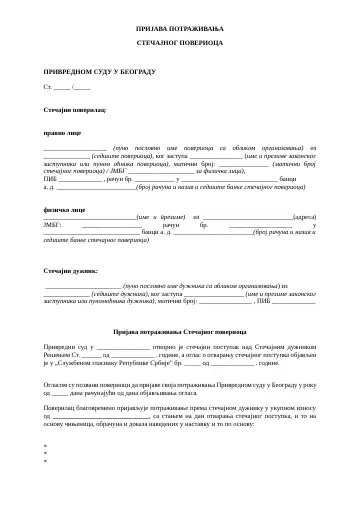
AOD forms. AOD has published three forms: the claim template for the court, the authorisation for an individual and the authorisation for a company. All are in Serbian Cyrillic; the claim is addressed to the Commercial Court in Belgrade, the authorisations let another person collect the insured amount up to €50,000. What to fill in is listed under each card.
Claim template for the court
Образац пријаве потраживања
The claim above €50,000 to the Commercial Court in Belgrade. Each depositor files it, individual or company.
the creditor: for an individual, full name, address, JMBG, account number and the bank holding it; for a company, registered name, seat, representative, registration number, PIB, account and bank;
the debtor: the bank’s name, seat, representative, registration number, PIB;
the court, number and date of the decision opening bankruptcy, number and date of the Official Gazette with the notice, the filing deadline in days;
the total claim on the day bankruptcy opened and what it is based on (listed points);
the list of attached evidence;
the request that the court recognise the claim (“утврди потраживање”): creditor, address, registration number, PIB, account and bank, amount;
place, date and signature.
Authorisation for individuals
Образац овлашћења за преузимање осигураног износа – физичка лица
Lets another person collect your insured amount up to €50,000 at Banka Poštanska štedionica. It is certified by a notary and dated no earlier than the day the licence was revoked (30.10.2026); authorisations issued before the revocation cannot be used.
on company letterhead: name, address, PIB, registration number, APR registration number (or another register);
the person authorised: name, position, address, ID card, JMBG;
the amount in dinars and in euros; the paying bank where the transfer order is submitted;
the representative’s signature and stamp;
attached: a register extract no older than 3 months on the day it is submitted to the paying bank.
If you have no JMBG. None of the three AOD forms says how to fill in the JMBG field if you do not have one (for example, a foreigner without a Serbian personal number); the court and AOD have not announced it separately either.
name (for a company, its registered name), address and contact address;
JMBG (for a company, its registration number);
account number;
the legal basis: the account or deposit agreement;
the amount, with the principal and the interest calculation shown separately;
for a secured claim, the asset over which you have a separate-satisfaction right (razlučno pravo) and the part of the claim that is not secured;
what exactly you are asking the court to recognise.
A foreign-currency claim is filed in that currency (para. 2). If the claim is in litigation, the claim states the court and the case number (para. 3). AOD has not published a separate list of attachments for ALTA: the template leaves blank lines for the evidence.
How it was at Univerzal — not instructions for ALTA
For Univerzal banka in 2014 AOD also asked for: the subject line “Пријава потраживања на име депозита код … банке у стечају”; how much the paying bank paid and when; what you claim plus contractual interest; the account and bank for payment; name, address, phone and JMBG under your signature; the contracts attached (AOD instructions, 2014). For ALTA the instructions may differ.
AOD’s written answers on the payout of up to €50,000 (separate limits for an individual and a sole trader, transfers only to an account in Serbia), with screenshots of the letters, are now on the page Payout up to €50,000.
First, the bank’s money covers the costs of the procedure, unpaid wages and the insurance AOD paid out. What is left is paid out by rank (arts. 19 and 20). Within one rank, creditors are paid in proportion to their claims for as long as the money lasts.
Rank I: private individuals, sole traders and micro, small and medium-sized companies, for the amount above €50,000. All on equal terms.
Rank II: taxes and other public revenues falling due in the 3 months before bankruptcy opened (except employees’ pension contributions).
Rank III: the National Bank.
Rank IV: other deposits: large companies, state bodies, persons connected with the bank.
Rank V: other creditors.
Rank VI: subordinated debt.
Rank VII: claims of creditors who are also shareholders of the bank (e.g. their loans to it); share capital is returned only from any surplus after all creditors (art. 20 item 7).
How it ended at Univerzal: rank I received about 96.5% of recognised claims after 6 years 7 months to 7 years 4 months, with no interest; rank IV about 17.5% (calculation and sources: Past cases).
No. Private individuals, sole traders and micro, small and medium-sized companies are in the first rank for the amount above €50,000 (art. 20 item 1 of the Law on Bankruptcy and Liquidation of Banks).
Should I file the claim for the remainder only after I receive the €50,000?
No, do not wait. These are two separate things. AOD pays the insurance of up to €50,000 itself through Poštanska; you do not apply to the court for it. Everything above €50,000 is a claim to the court, within 90 days from publication of the notice in the Official Gazette (court decision 10 St 275/2026, item IV; art. 7). This deadline runs regardless of the payout: if you wait for the insurance, you may miss it. Example: you have €80,000 in your accounts. AOD pays €50,000, and you file a claim with the court for €30,000. You can file right after publication in the Gazette: the notice was published on 06.11.2026.
Is there a 120-day or six-month period for the claim?
No. File within the deadline the court set: 90 days from publication. The fallback of up to 120 days costs money and guarantees nothing. Why: for banks the court sets the deadline (art. 7). Where the bank law is silent, the general Law on Bankruptcy applies (art. 22 of the Law on Bankruptcy and Liquidation of Banks). That law lets you file late, up to 120 days after the notice is published, but only if you pay in advance for an extra hearing; if you don't pay, or you file after 120 days, the claim is rejected (art. 111 paras. 5 and 8). For Univerzal in 2014, AOD itself wrote "60 days (general deadline 120 days)", but an older law applied then.
Are a personal account and a company account counted together?
No. A company (DOO) is a separate legal entity with its own tax number and its own limit, if it is micro, small or medium-sized (art. 2 of the Law on Deposit Insurance).
I have both a deposit and a loan at ALTA. Is it offset automatically?
Not necessarily. If the deposit secured that very loan, AOD subtracts the debt when it pays the insured amount (art. 16 para. 2 of the Law on Deposit Insurance). In any other case you can offset the deposit against the loan only if you file a claim for the full amount, with a set-off statement, before the claim deadline. The right to offset must have existed before the bankruptcy petition was filed (art. 82 of the Law on Bankruptcy; bans and exceptions in art. 83). Ask a lawyer, and keep paying the loan in the meantime.
Is a class action or petition needed?
No. Each creditor files their claim themselves with the court handling the bankruptcy, within the deadline in the court decision. A petition does not affect the payout.